21 Jan Lissyviggeen Stone Circle
“…parallels to the ‘Merry Maidens’ may be found in folklore and the testimony from witch trials. This belief may, therefore, have resulted from Church propaganda to halt ‘non-Christian’ ceremonies at the megaliths.”
S. P. Menefee, 1974 1
Click the image above to enter the virtual-reality tour.
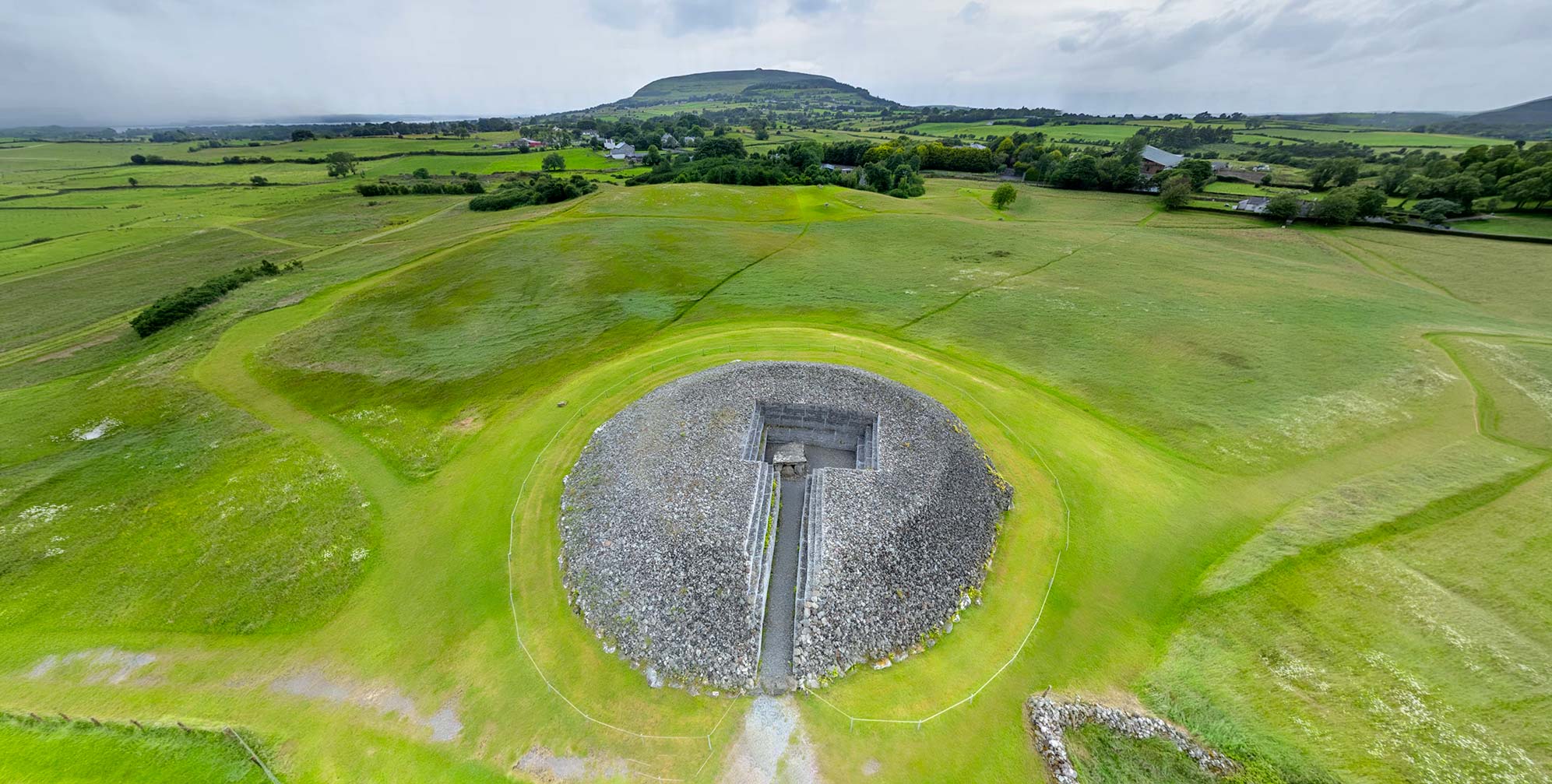
Step off the road a few kilometers east of Killarney, and the tourist bustle falls away into quiet pasture and low fields. Ahead, beyond a farm gate and a fringe of trees, a ring of weather‑darkened stones rises from the grass, backed by a ragged earthen bank. This is the Lissyviggeen Stone Circle, a compact prehistoric monument that for generations has inspired stories of druids, dancing children and goddesses.
Visitors today reach the site along minor roads and farm tracks; without a signpost, it projects a rather mysterious atmosphere, hemmed in by trees and fields. Approaching from the south, the first impression is dominated by the great stone paired portal, before the low earthen bank and the compact seven‑stone ring become visible within a sheltered hollow. Standing between the two outliers and looking along the axis through the entrance towards the axial stone gives a sense of structured approach, as if one were passing through a monumental doorway into a small, defined ritual space.
Lissyviggeen’s axis, running from the gap between its portal stones through the center and out across the axial stone, fits this pattern. On short winter days the sun would drop towards the hills in roughly the same quadrant that the axial stone marks, giving the circle a subtle seasonal “tilt” that would not be lost on people living so closely with the rhythms of light, weather and pasture.2
For people living in rural Kerry centuries later, the origin of this strange, embanked ring called for a different kind of explanation. That is where folklore steps in. Locals know Lissyviggeen as the “Circle of the Seven Sisters”, after a tale in which stones become people and people become stones again, as told below by John Moynihan in the 1930s.
“There was a high-druid there long ago who had great magic power. …The greatest day of all in the eyes of these old pagans was Mayday and on the eve of that feast they had great gatherings of their druids and magicians.
Well, the law was that nobody living should dare dance or enjoy himself at that time until May-eve had passed. The high druid came here to this very field to perform his magic rites but what did he and his fellow druids find but seven children dancing by the light of the moon and the parents looking proudly on!
Filled with rage at this breach of the law he raised his magic wand and turned father, mother and the seven children to stone. In spite of his magic powers he could not compel them to remain always in that form. So every May eve they regain their human form and the children dance round in the midnight air while their parents look on at their caperings. Before cock-crow they are back again in their forms of stone and you would not hear gíog nor míog out of them for the rest of the year.” 3
Another version of the “Merry Maidens” tale turns the parents into pipers, their tall stones flanking the approach so they can forever play for the children’s ghostly dance. Every May Eve, some say, the spell briefly lifts for a few heartbeats and the nine stones become human again, dancing until the first grey of dawn drives them back into silence. Crofton Croker (1853) was told a different legend about the stones.
Like many Irish legends attached to ancient monuments, this is a moral tale as well as a place‑story. It warns against disobedience and impiety, yet it also preserves the memory of certain charged times – May Eve, the season of moving cattle to summer pasture; night‑time, when boundaries blur and the dead or the Otherworld draw near. The details are Christianized, but the setting is still the Bronze Age circle.
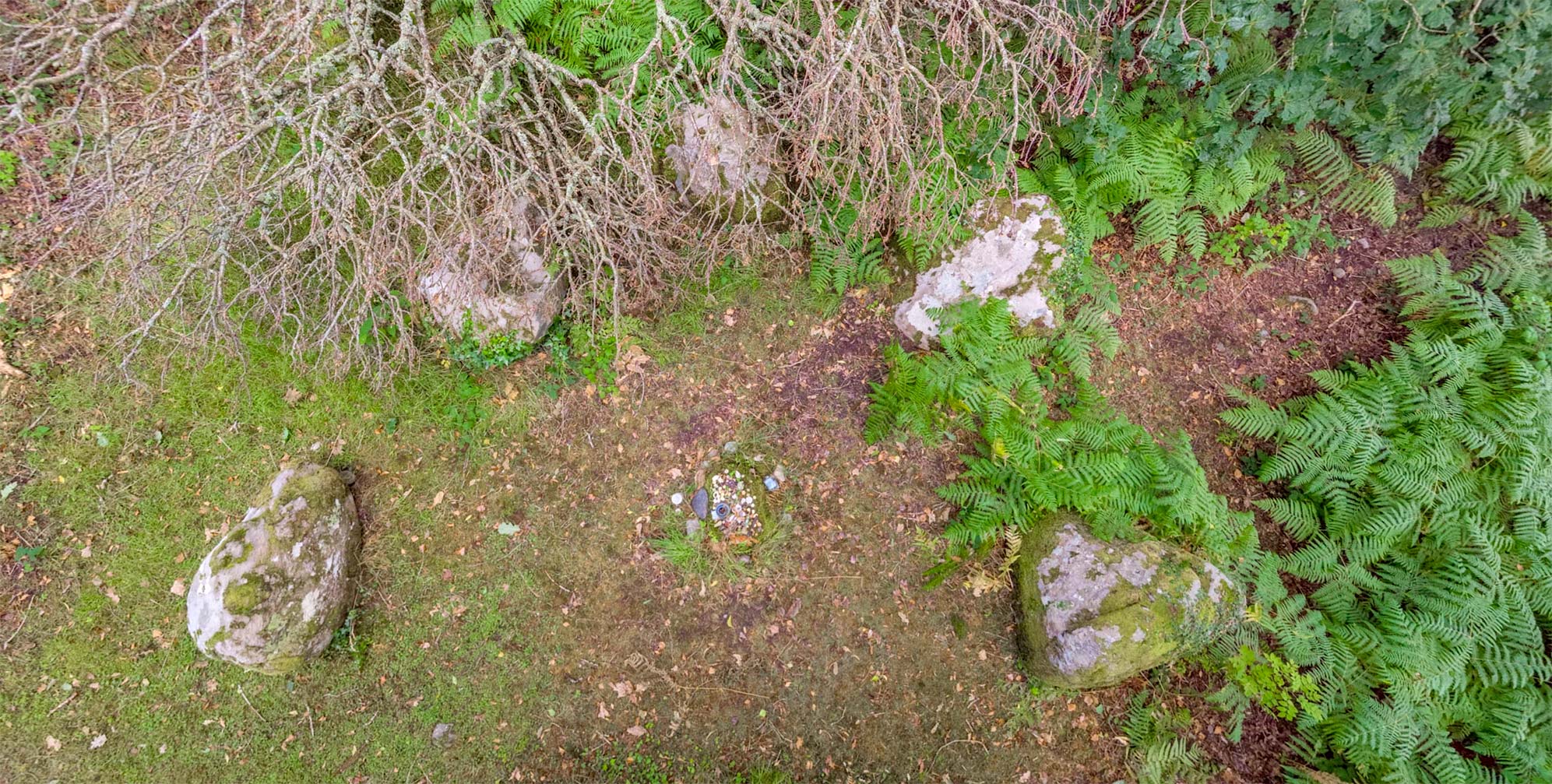
Lissyviggeen is part of a distinctive family of Bronze Age stone circles that dots the uplands of Counties Cork and Kerry. Unlike the sprawling rings at better‑known sites, this one is intimate: just seven stones forming a tight circle about four meters across, the tallest barely up to an adult’s chest. They are not placed at random. Two slightly higher “portal” stones mark an entrance on the eastern side, while directly opposite them sits a lower “axial” stone on the south‑west, the point where the circle’s invisible main axis meets the setting sun on some days of the year.4
What sets Lissyviggeen apart is everything around it. The little ring does not stand alone in the field; it is cradled by a broad earthen bank roughly twenty meters across, like a shallow circular embankment or low fort. Two gaps opposite each other break this bank, one loosely lining up with the stone entrance, the other facing away into open country. And farther south again, beyond the bank, stand the two massive portal stones – more than two meters high – set a little over two meters apart like a stone gateway.
The bank is more than decorative; its two opposing gaps may once have controlled how people entered and left the interior.
Stand between the two big outlying stones and look towards the circle, and a quiet logic emerges. The pair forms a kind of outer gate. Beyond them, the bank holds the eye, curving around until the seven stones appear, their tallest uprights framing an entrance on the eastern side, facing the sunrise half of the sky.
To walk in from the south is to pass between these great paired uprights, step across the lumpy bank and find yourself facing the seven smaller stones. The effect is quietly theatrical, as if the monument were designed to stage an approach: large stones outside, bank enclosing, and then the low inner ring at the focus.
Archaeologists cannot yet give Lissyviggeen an exact date because it has never been excavated, but it seems similar to other circles in the Cork–Kerry tradition whose dates are better known. At Drombeg and Bohonagh in County Cork, and at Cashelkeelty in the hills above Kenmare Bay in Co. Kerry, excavations revealed small pits in or near the center of circles containing carefully buried cremated human remains. Flint arrowheads, simple scrapers and a coarse, flat‑bottomed pot link these burials to the late Neolithic and early Bronze Age, around the middle of the second millennium BC.5
Radiocarbon dates from nearby stone rows – short lines of standing stones that share the same architectural “grammar” as the circles – cluster around 1400–1300 BC, suggesting that this whole complex of circles, rows and isolated monoliths belongs to a long-lived ritual landscape in the early Bronze Age. Lissyviggeen sits inside the edge of that world.
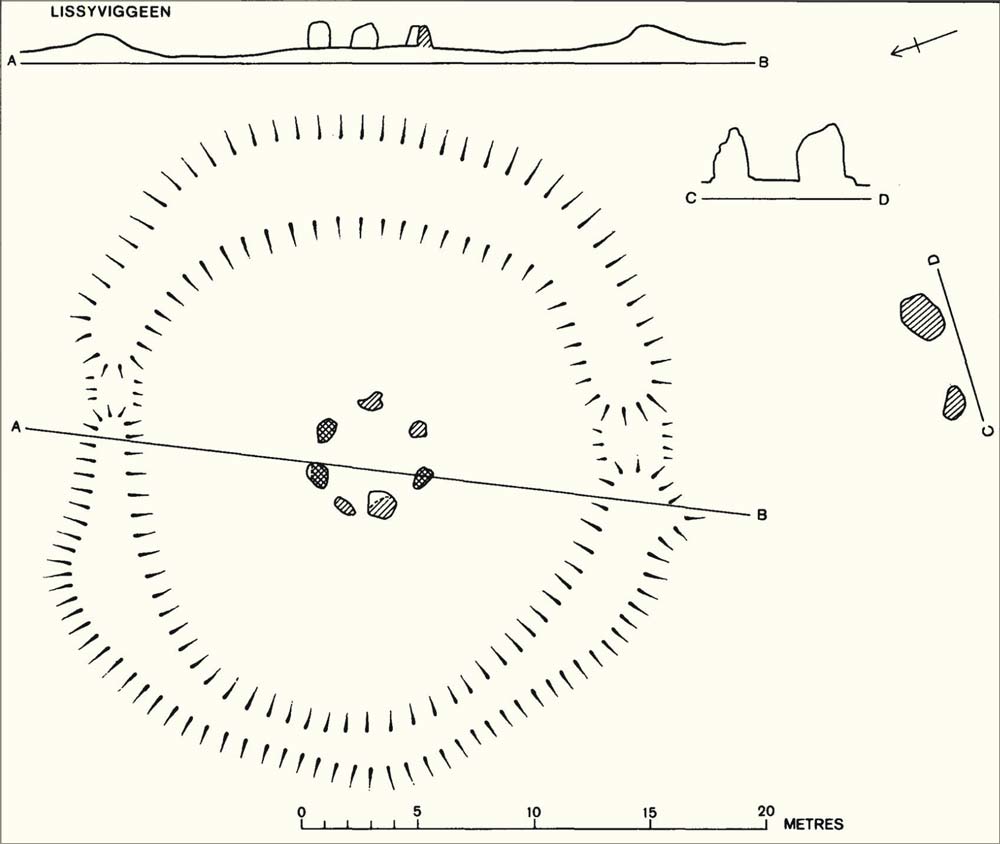
Across from that entrance sits the axial stone: smaller, lower, and always on the western half of the circle. When archaeologists plotted the axes of nearly sixty Cork–Kerry circles, including Lissyviggeen, they found that they all fall within a broad arc of the setting sun between south and west, clustering around winter positions rather than the high blaze of midsummer. The alignments are not razor‑sharp observatories; precision is not the point. Instead, the builders seem to have wanted their monuments to acknowledge the great daily and yearly swings of light and darkness, orienting gatherings along the path the sun takes across their sky.6
More recent interpretations look past the druid and the scolding tone of prohibition on dancing, to see something older and more ambiguous in the stones. Modern writers have mapped the “Seven Sisters” onto a family of powerful female figures from Irish tradition: the sovereignty goddesses of the island, the three war‑sisters of the Morrígan, and Anu, a mother‑goddess whose name lingers in nearby hill names such as the Paps of Anu north‑west of Killarney. This is informed imagination rather than proven survival, but it reflects a long habit of seeing stone circles as embodiments of land, fertility and female power.
In Kerry, this imaginative layer sits next to a very real seasonal practice that echoes the old circle’s concern with light. For at least a century and a half, communities across the county built great communal bonfires on St John’s Eve, 23 June, burning turf, brush and old furze in cone‑shaped piles that flared against the lingering midsummer dusk. People brought embers home to bless their hearths, led cattle around the flames for protection, and remembered scraps of prayers said as the fires were lit.7
An account from the 1930s describes a St John’s Eve fire blazing at Lissyviggeen whose flames could be seen for miles. One local, Donie O Keefe, remembered decades later:
“Long ago a few days before Bonfire Night all the young men and boys were busily engaged gathering sticks, turf and other kinds of fuel. When they had enough gathered they made them all up into one big heap so as to have a blaze fire. When the sun went down all the neighbours gathered around. The fire was lighted and the flames could be seen for miles. Then all at once there was wild applause cheering, shouting, and singing of Irish songs. Some few in the crowd had mouth-organs bugles and other musical instruments. Then the old men and women danced jigs and reels and when they sat down they talked and smoked while the young men danced.” 8
In that moment, the old circle at Lissyviggeen was once again a gathering place at the edge of day and night, drawing people into a ritual of light, heat and community – much as it probably did when its stones were first raised more than three thousand years ago.
Click here to see all the notes from this page. Parts of this page were drafted using AI technology; all content has been edited by the author.
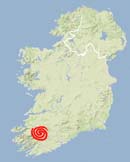
Lissyviggeen, Co. Kerry
Nearest Town: Killarney
Latitude: 52°03’31.3” N
Longitude: 9°27’45.1″ W