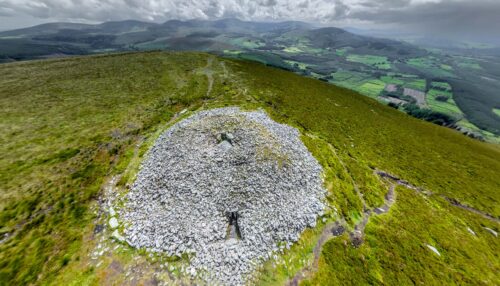
25 Jan The Hill of Ward
(Tlachtga)
“On Samhain night today, the hill once more glows. In Athboy’s Fair Green, families gather for face‑painting and storytelling before joining a torchlit procession that winds up the old road toward the earthworks. Robed figures carry banners marked with suns and spirals, and an organiser calls to the crowd: ‘Let’s raise our voices together and call back Tlachtga from the mist of time.’”
Erin Mullally, 2016 1
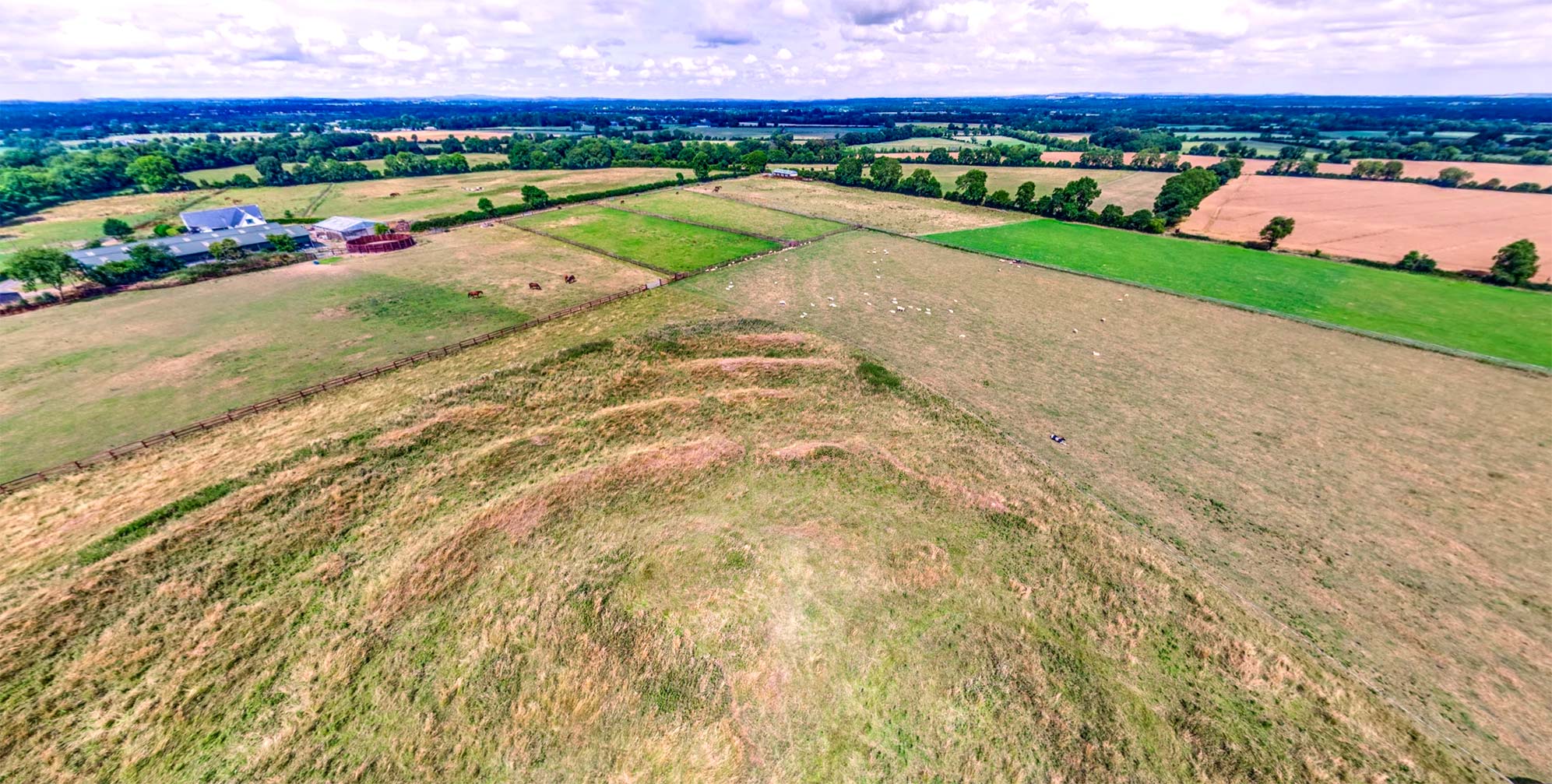
Click the image above to enter the virtual-reality tour.
Wind whips across the Boyne Valley as dusk gathers on the last night of October. On the low, ridged rise outside Athboy, hundreds of people climb toward a ring of banks and ditches, their torchlight flickering where, two millennia ago, another fire is said to have marked the turning of the year between light and darkness. This is the Hill of Ward, Tlachtga, a place where archaeology, folklore, and mythology converge so tightly that the story of Samhain—and later Halloween—seems to smolder in the soil.
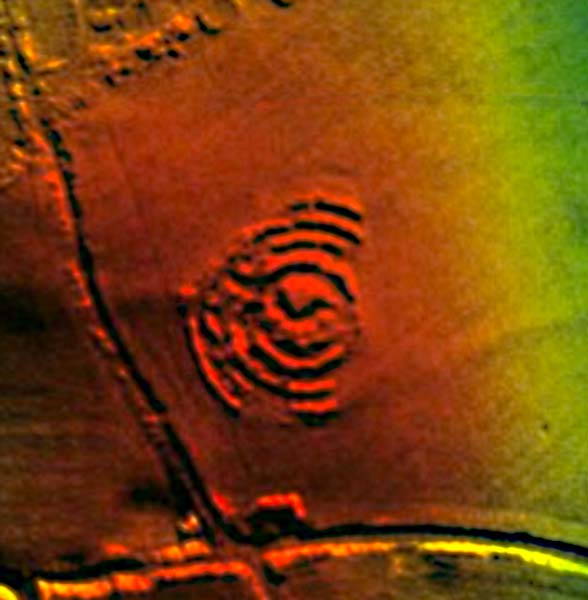
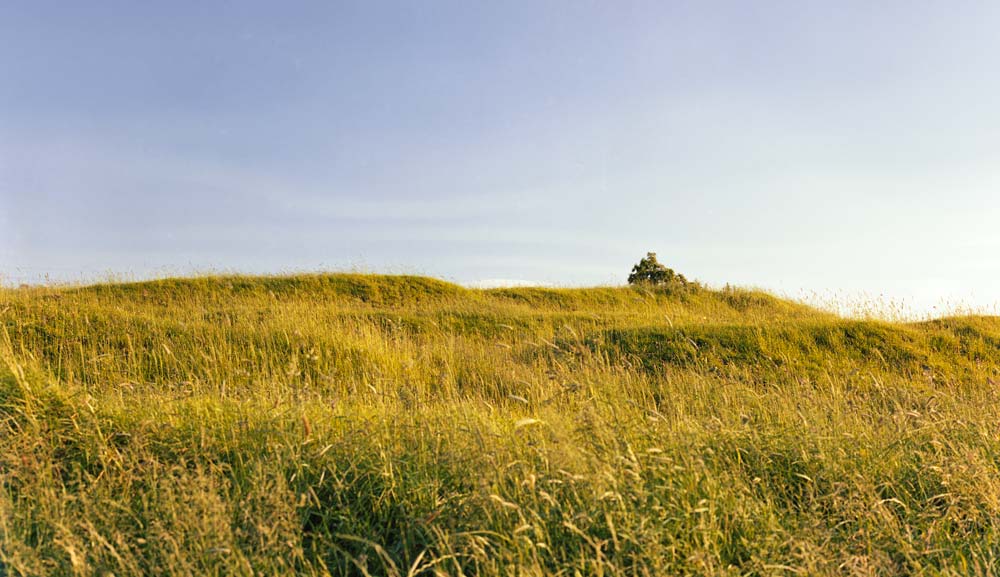
From afar, Tlachtga looks modest: a rounded pasture rising only about 40 metres (131 ft.) above the surrounding fields, its summit just 119 metres (390 ft.) above sea level. Yet it commands sweeping views to some of Ireland’s most storied ritual landscapes—the Hill of Tara, Loughcrew, and Teltown—all visible on clear days across the low Meath countryside. On the hilltop, four concentric earthworks enclose a circle roughly 140–150 metres (460-492 ft.) across, their best‑preserved banks over a metre high, with an outer shallow ditch bringing the monument’s full diameter to about 170 (558 ft.) metres.
Archaeologists now know this is only the latest layer in an extensive architectural puzzle. Geophysical survey and excavation reveal that the visible four-walled enclosure overlies an earlier, tightly spaced hillfort of three walls, about 195 metres in diameter, built in the Late Bronze Age, and a smaller subcircular enclosure to the south, roughly 40 metres (131 ft.) across. Beyond the summit, LiDAR has picked out a previously unknown embanked enclosure of “saucer” form comparable in size to the great ceremonial enclosures of the Boyne Valley, as well as barrow‑like mounds, ring‑ditches, and traces of settlement.2
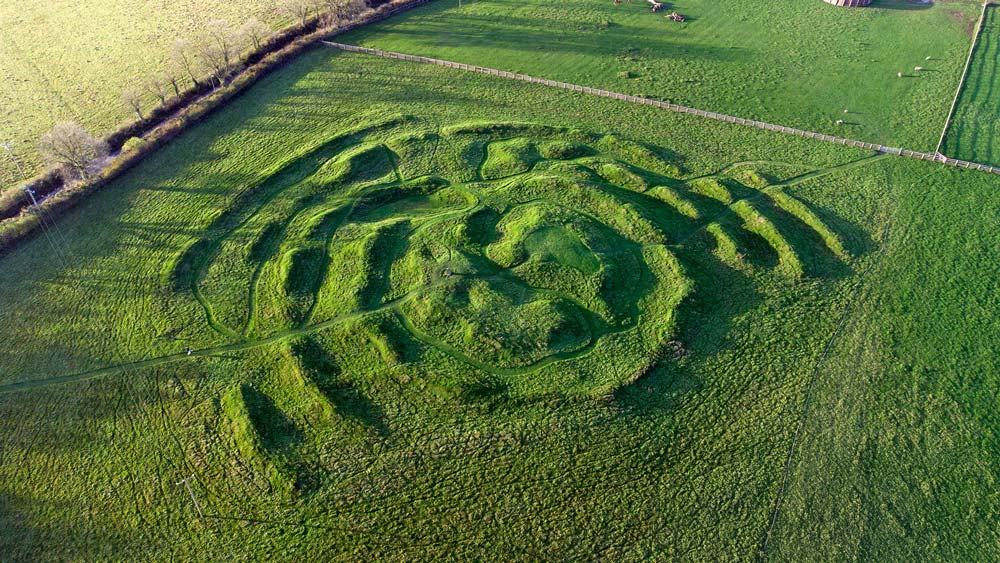
Taken together, the surveys and excavations show Tlachtga was no isolated fort on a farmed ridge but part of a dense ritual and political landscape: a node in a network of enclosures, routeways, graves, and assembly places where power was performed in earth and fire.
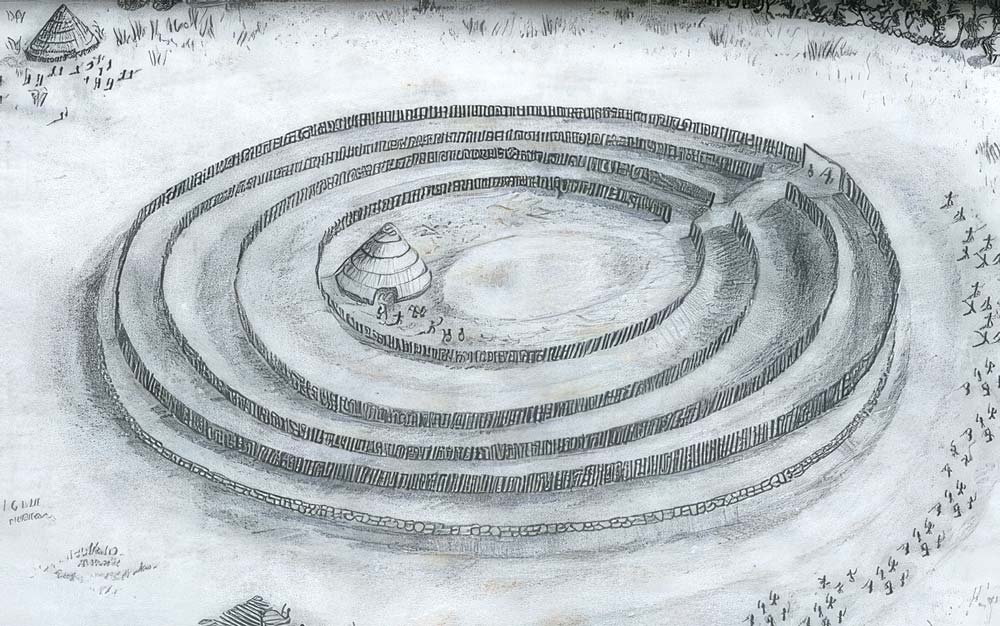
If the banks and ditches give Tlachtga shape, fire gives it meaning. Medieval tradition, most famously preserved by Geoffrey Keating in the 17th‑century, places here the great Samhain fire from which all other flames in Ireland were kindled on the eve of November. At this liminal night, marking the end of the old Celtic year and the beginning of the new, all household hearths were said to be extinguished, then relit from a blaze on this hill, as torches carried the new year’s flame outward toward Tara, Loughcrew, and beyond.3
Samhain, as both early texts and later folklore suggest, was a dangerous threshold. It was the time when livestock were culled and fields lay bare, when the sun seemed to weaken and “the spaces between” worlds grew thin. The spirits of those who had died since the previous year were thought to move on, and the living sought to appease or outwit the dead with offerings, disguises, and divination—echoes of which persist in our costumes, jack‑o‑lanterns, and ghost stories.4
There were other assemblies on the Hill beyond those connected to Samhain. As recounted in a 1934 textbook:
“In 1167 13,000 horsemen were said to have crowded the roads leading to the hill of Tlachtga on the occasion of High King Ruaidrí Ua Conchobair’s national synod of kings and prelates which enacted ‘good decrees regarding veneration for churches and clerics and the property of the Church.’” 5
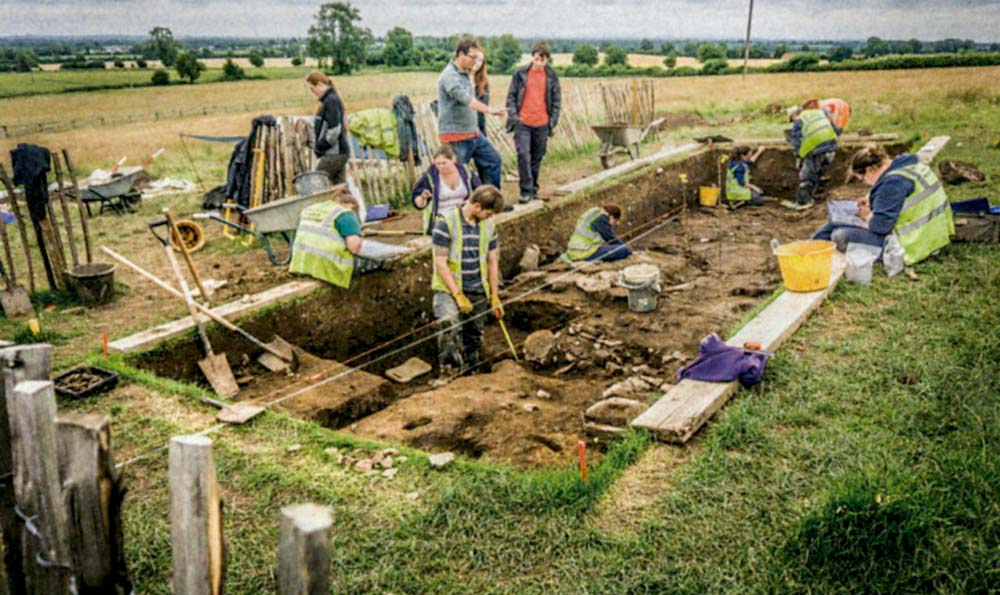
Modern fieldwork has begun to catch up with the weight of this story. Archaeological projects conducted over the last decade have combined LiDAR, geophysical survey, and small but strategic excavations to peel back the layers of Tlachtga’s past.
Recent excavations on the hill have uncovered layers of intense burning and large quantities of animal bone distributed through all three main phases of activity, clear signatures of repeated large‑scale fires and feasting. Archaeologist Steve Davis and colleagues caution that the burning could also relate to metalworking, pottery, or even glass production—crafts that transform matter in ways that may themselves have been seen as magical. Yet the absence of everyday settlement traces, paired with paths in the landscape linking to satellite enclosures, strongly suggests Tlachtga was reserved for episodic gatherings, rituals, and assemblies rather than routine domestic life.6
The hill’s mythic power centers on a woman whose story is as jagged as the broken banks that bear her name. Medieval Dindshenchas—place‑lore poems explaining how places were named—tell of Tlachtga, daughter of the formidable druid Mog Ruith. In the most elaborate version, preserved in the Metrical Dindshenchas, Tlachtga travels “to the East” with her father to learn the magic arts “practiced anywhere in the world.” There, she works with Mog Ruith, who decapitated John the Baptist, and the notorious heretic Simon Magus to create three potent objects: the Roth Ramach or “rowing wheel,” a mysterious moving wheel of doom; a stone at Forcarthu; and a pillar at Cnamchaill. Whoever sees the wheel, the poem warns, will go blind; whoever hears it will be deaf; whoever touches it will die.7
“Tlachtga, proud and princely hill, has seen the passing of many a stern king, since long ago seemly Tlachtga possessed it…” 8
Scholars have likened this strange device to a bull‑roarer, a whirled wooden “flying machine” whose unearthly sound marked initiation rites in far‑flung cultures. Others, drawing on later Christian prophecy, cast the wheel as an apocalyptic ship of a thousand beds, destined to crush heretics before Doomsday. In some retellings, Tlachtga bravely breaks the lethal wheel, in others she is praised as its maker and ally of Simon; in still later texts she is blamed for the death of John the Baptist, the guilt of her father transferred to her in a terse line that accuses her of having “slain a martyr.” 9
Yet it is not for sorcery that the hill is named, but for her death in childbirth. Returning to Ireland, Tlachtga reaches the Boyne Valley, heavily pregnant by the three sons of Simon Magus, who, in two versions of the story, had raped her as punishment for her magical work. On the hill she bears three sons—Doirb, Cuma, and Muach—each from a different father, and each giving his name to a region. After this triple birth she dies, and a great earthen fortress is raised over her grave. So long as the sons’ names are remembered, the lore promises, no foreign catastrophe will befall Ireland.10
In this narrative, Tlachtga stands among a pantheon of powerful women whose bodies and deaths inscribe the ritual landscape: Tea at Tara, Tailtiu at Teltown, Macha at Emain Macha. But unlike those more benign figures, later Christian writers seem to reserve a particular hostility for her—perhaps because she straddled too uncomfortably the line between indigenous ritual authority and forbidden magic.
Radiocarbon dates show that the main hilltop complex evolved in at least three major phases. The earliest substantial enclosure—a hillfort with a series of closely‑set earthen walls—belongs to the Late Bronze Age, part of a growing body of evidence that such large, ringed hilltop monuments were being built across Ireland as focal places for power, ceremony, and perhaps refuge. Later, in the Iron Age and early medieval period, today’s visible four‑banked enclosure was constructed and repeatedly remodeled, accompanied by burials, intensive feasting, and evidence of craft production, including metalworking.11
One “remodeling” may have seen the destruction of sections of the banks during one of the campaigns of Oliver Cromwell following the Rebellion of 1641.. John O’Donovan wrote in 1836 that, “Traditions says that the General, Owen Roe O’Neill, cut up this fort into a Foslongphort [a temporary encampment].” 12
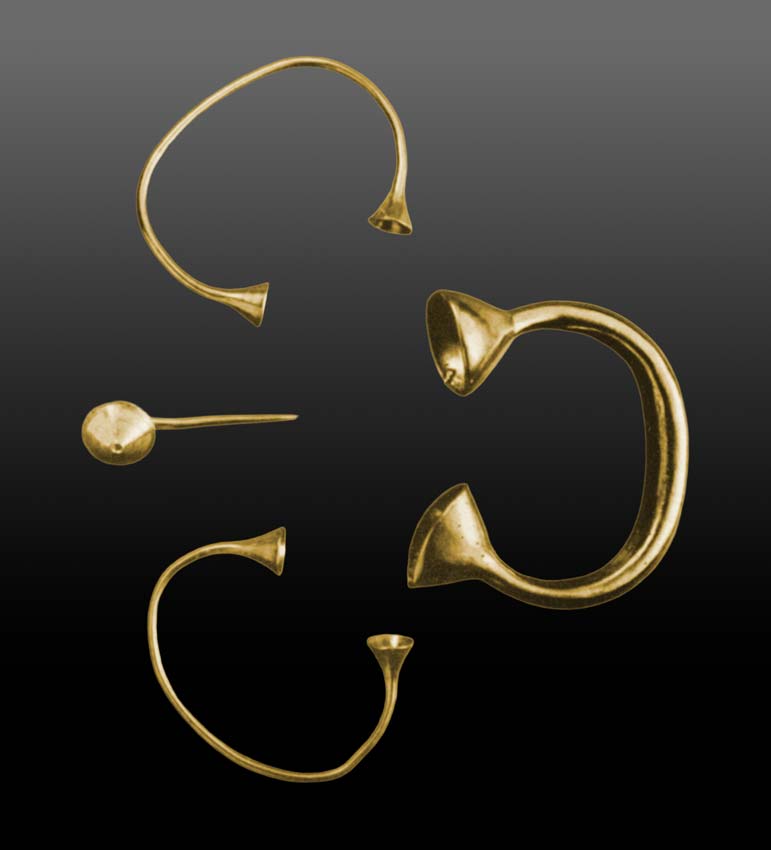
One particularly poignant find was the carefully buried skeleton of an infant of about seven to ten months, dating to around the fifth century AD, interred near a ritual deposit of cow bones. A similar child burial is known from the Hill of Tara, hinting at a shared ritual vocabulary of sacrifice, commemoration, or elite display across royal centers in the Boyne Valley. At Tlachtga, a nearby buried treasure of golden objects, the Drissoge Hoard, demonstrates traces of high‑status metalworking (see photo).
Evidence for remodeling in the eleventh to thirteenth centuries suggest that the hill retained significance well into the medieval period. At some point in this era, a central mound was heaped within the inner enclosure—perhaps, one reviewer suggests, a rare example of a pre‑ or early‑Norman motte capped by a timber structure, a visual statement of lordship layered atop much older sacred ground.13
Around the hill, LiDAR has revealed parallel outer banks guarding the gentlest approach, echoing the linear earthworks seen at other royal sites; a large, very low embanked “saucer” enclosure east of an early church; a cluster of ring‑ditches; and a possible medieval settlement with rectangular buildings and a bawn‑like enclosure. Before these surveys, only the hilltop ringwork and a nearby church and holy well were recorded in the immediate area; now, Tlachtga sits in a newly recognized web of prehistoric, early historic, and medieval features.
“Tlachtga no longer stands as an isolated monument but is clearly part of a richer archaeological landscape, with a likely Neolithic (embanked enclosures) and Bronze Age (barrow) presence in the immediate vicinity, as well as evidence of both early (possible ringforts) and later (settlement) medieval activity.” 14
The modern festival, part historical pageant, part spiritual observance, grew out of local efforts in the late 1990s and early 2000s to reclaim Tlachtga’s forgotten status as one of Meath’s great ritual hills. It is consciously framed as a continuation—not a literal re‑enactment—of the Samhain fire ceremonies described in medieval sources and fed by centuries of lore that made Tlachtga “the birthplace of Halloween.”
Thomas O’Current, citing traditional medieval sources, listed in 1873 the different functions of such a celebration:
“In the first place it was the great school where the people learned to know their rights and duties, the special laws under which they lived, the history of the country, the warlike deeds performed by the illustrious dead, and the genealogies of the families entitled to rule them. In the second place a fair was the occasion of enjoyment to the people – — dancing, music, recitation of poetry, feats of arms, athletic sports, horse-racing and juggling formed part of the essential business of it. And lastly it was a great market for all kinds of wares and produce.” 15
For archaeologists, the revived bonfire and procession are more than spectacle. They draw attention to a site that, until very recently, lagged far behind neighbors like Tara and Newgrange in both research and protection, despite early scholars’ warnings that such “royal sites” often conceal far richer archaeological landscapes than their modest modern appearance suggests. For locals, the festival re‑anchors community identity in the deep time of their own fields, tying farming schedules and school calendars to a hill that once paced the year for an entire island.
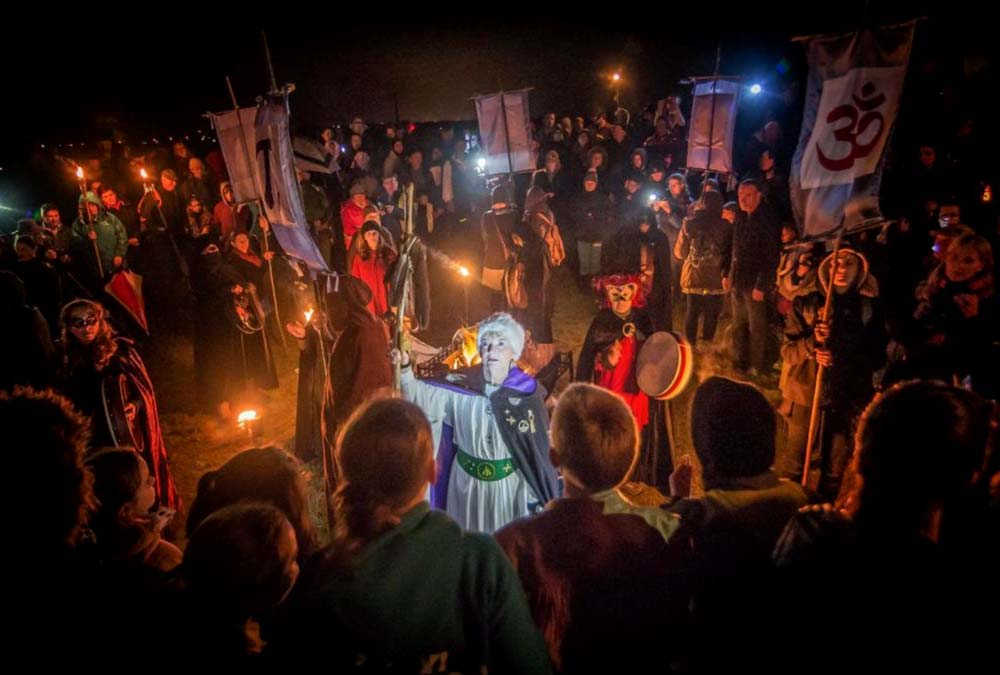
Standing within the innermost bank as the new fire crackles, it is hard not to feel how layered Tlachtga has become. Beneath your feet lie Neolithic axes, Late Bronze Age ditches, Iron Age feasts, an early medieval child’s grave, perhaps a lost passage tomb, perhaps a medieval motte. Above you, the dark sky reflects modern torchlight, and the old stories—of a druid’s daughter, a lethal wheel, a triple birth, a national assembly, a hill that once commanded the year—still circle like sparks on the wind.
Click here to see all the notes from this page. Parts of this page were drafted using AI technology; all content has been edited by the author.
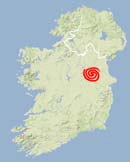
Athboy, Co. Meath
Latitude: 53°37’30.1″ N
Longitude: 6°53’11.1″ W