


23 Dec Deerpark Court Tomb
and Cashel
“What, then, is this curious edifice? It can hardly be a tomb, it is so unlike any other tomb which we know of. In plan it looks more like a temple; indeed it is not unlike the arrangement of some Christian churches; but a church or temple with walls pervious, as these are, and so low that the congregation outside can see all that passes inside, is so anomalous an arrangement that it does not seem admissible. At present it is unique.”
James Fergusson, 1872 1
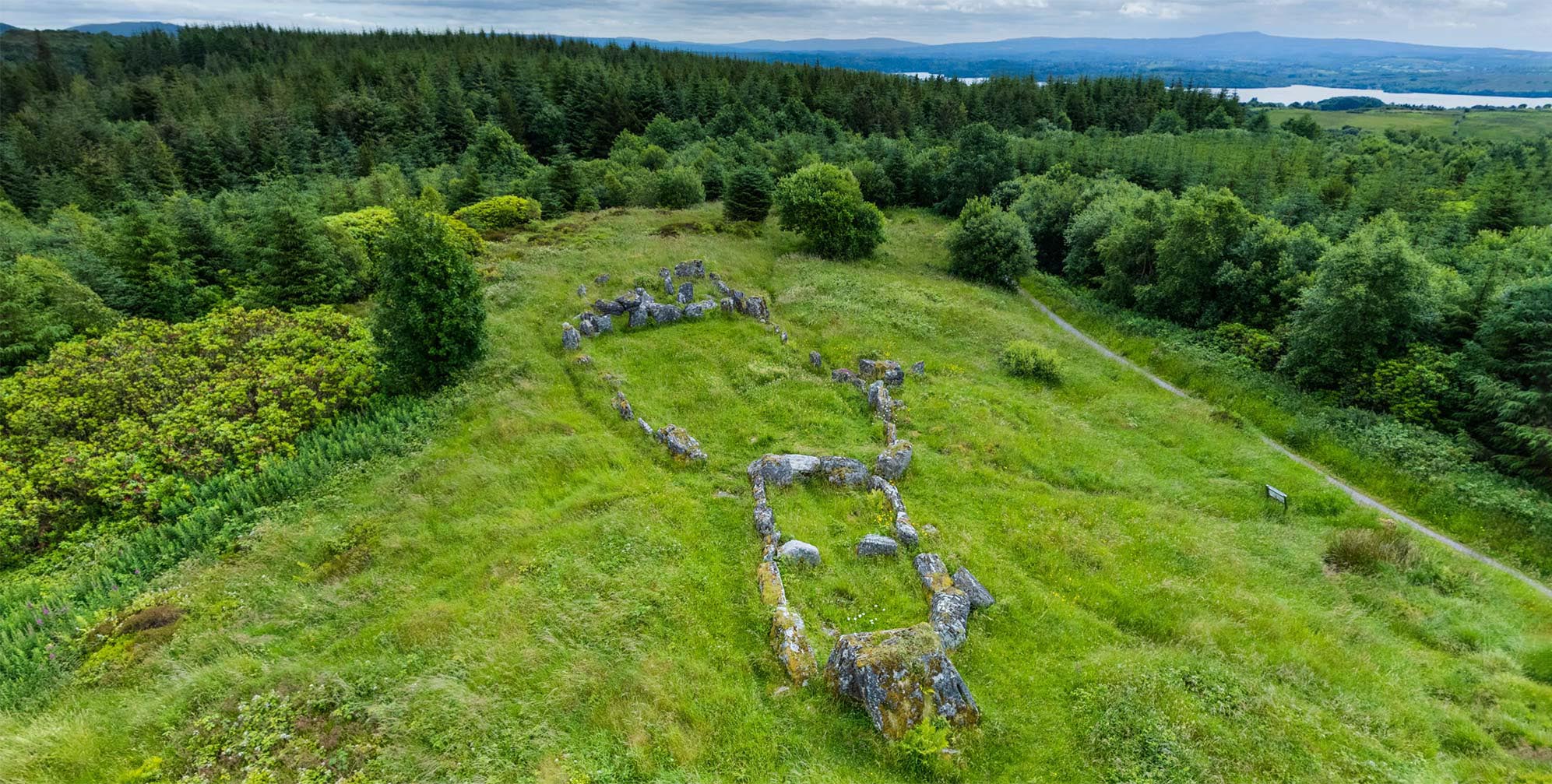
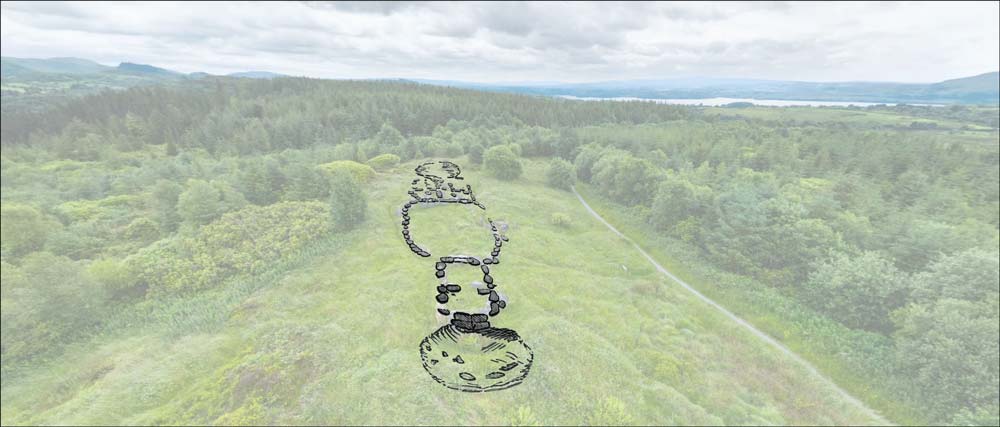
Click the image above to enter the virtual-reality tour.
There are few prehistoric monuments in Ireland that have been given so many identities, and yet so little of a story of their own. The great megalithic structure at Magheraghanrush has been called a stone circle, a temple, a sepulcher, an “Irish Stonehenge,” and—on the early Ordnance Survey map—the Giant’s Grave. It is now classified as a central-court tomb. None of these names, however, quite prepares the visitor for the strange congregation of limestone uprights standing on the exposed hill above Lough Gill.
The monument occupies a commanding position, about 152 m (500 ft) above sea level. From the hilltop the Table of O’Rourke may be seen to the east, Lough Gill to the south, Sligo to the west, and beyond it Knocknarea, crowned by the great cairn known as Queen Maeve’s Cairn (Meascán Mhéabha). Benbulben and its limestone companions dominate the northern horizon. Edward Hardman, who published the first detailed survey in 1879, noted that Deerpark points westward toward Knocknarea. The relationship may be deliberate—or it may be one of those tempting conversations between monuments that began only after their builders had disappeared.2
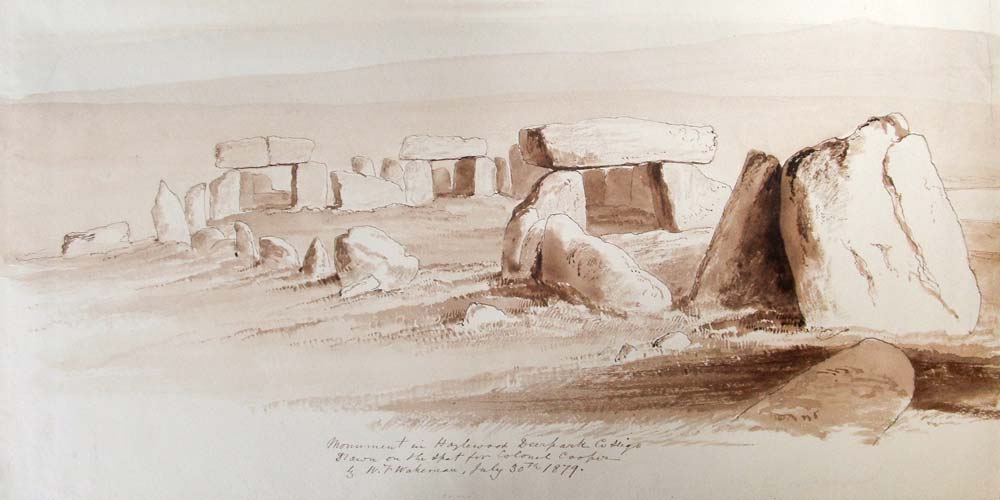
Hardman measured the complete structure at 44 m (144 ft), including the disturbed stone mounds at either end. The central court was approximately 15.4 m (50 ft) long and 8.5 m (28 ft) across at its widest point. Three galleries opened from it: a single gallery at the west, and two parallel galleries at the east. Low entrance portals, each formed by two uprights supporting an immense lintel, still give the tomb its most dramatic feature. Some of these capstones are 2.4 m (8 ft) long and perhaps 60 cm (2 ft) thick.
The plan seemed to Hardman curiously like that of a Christian church. He imagined a chancel, nave, crossing and side aisles laid out in rough limestone. The comparison was architecturally ingenious but chronologically extravagant: the monument was already ancient long before the first church appeared in Ireland.
W. G. Wood-Martin had a similar observation:
“The general resemblance of the plan taken in its entirety to that of a modern cathedral: the western end may be said to represent the chancel, the central enclosure the portion under the dome, whilst the eastern extremity is not without analogy to the nave with side ‘aisle.’”
“…the rude appearance of the rocks, and the indifference shown as to size or arrangement, although there is symmetry in the general structure, would seem to point to a more primitive age than that of Stonehenge. Unless, indeed, we are to suppose the Irish of that period were behind their British neighbors in civilization.” 3
More recent study places Deerpark among a small and unusual group of central-court tombs concentrated in the northwest. Its court (the open space in the center of the monument) was not an enclosed room in the modern sense, but an open-air ceremonial space where a community might gather before selected members entered the burial galleries.
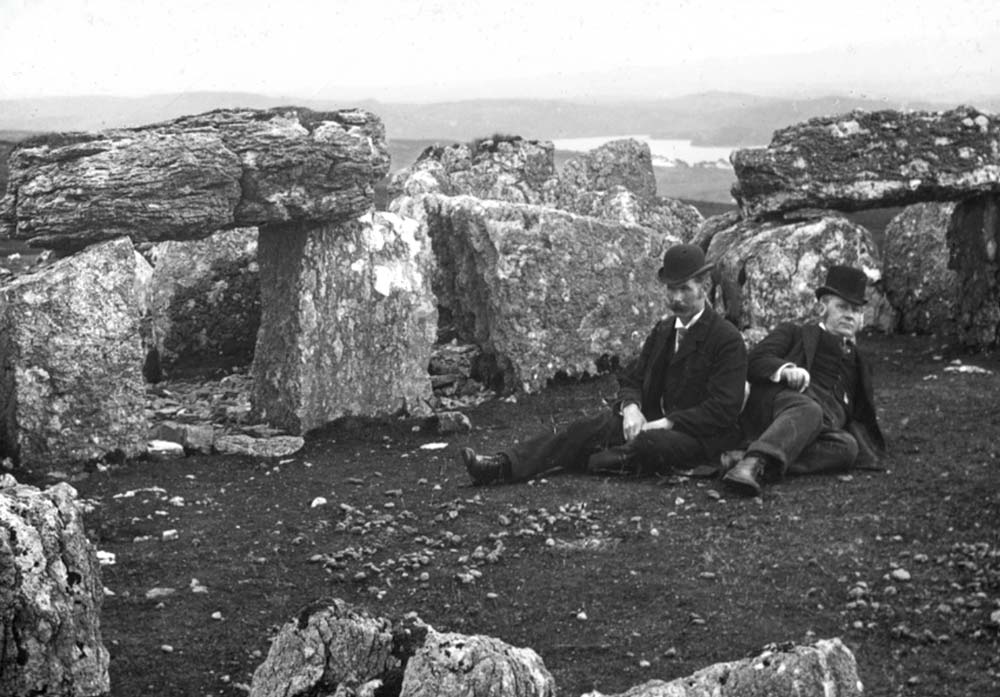
The lintelled entrances are low enough to require a visitor to stoop if the lintels were still in place.. Beyond them, projecting stones divide the galleries into chambers. Hardman called these internal divisions “passage stones” and wondered whether they marked stations used during ceremonies.
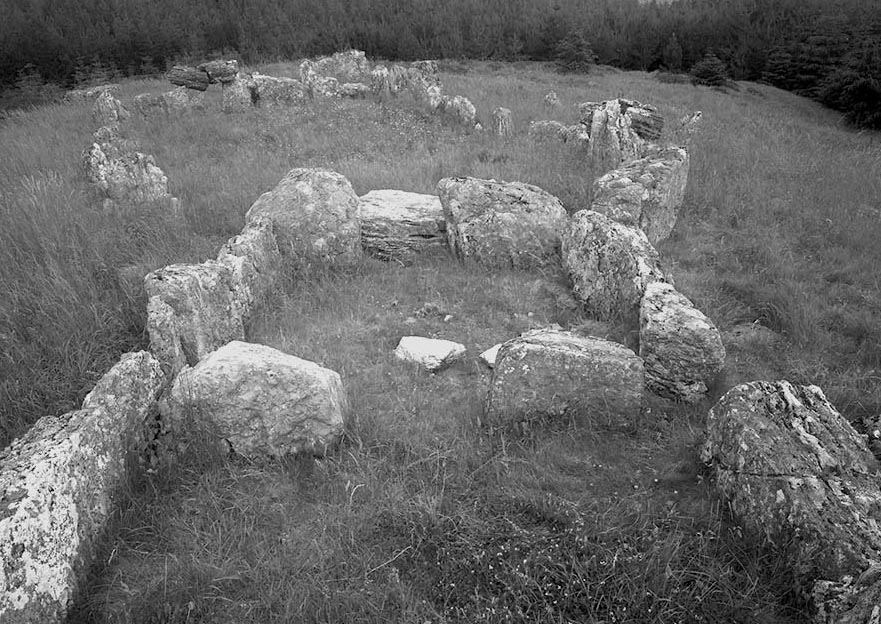
The suggestion was speculative, but his instinct that the tomb was built for ritual was surely correct. Court tombs were not simply containers for the dead. They were places where burial, memory and communal identity were given architectural form.
Hardman nevertheless concluded that Deerpark could not have been sepulchral, since the limestone bedrock lay close beneath the surface. Later investigation proved him wrong. Human bones—belonging to men, women and children—were reportedly recovered from the monument, together with a worked flint object. Deerpark was indeed a house of the dead, although probably one used repeatedly rather than sealed after the burial of a single individual.4
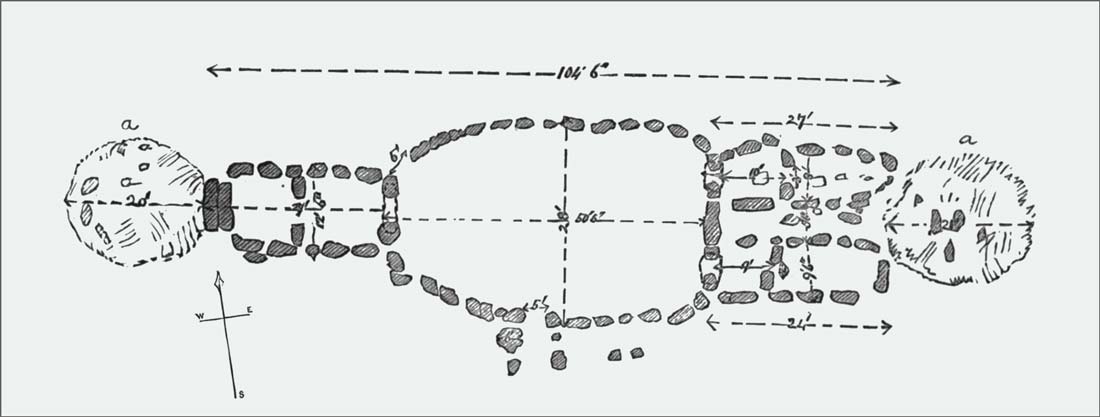
Plan of the Court Tomb, drawn by E. T. Hardman in 1879.
Note the circular areas at each end labeled “a.” Of these W. G. Wood-Martin wrote in 1887,
“At either end there is a slightly-defined mound, about 20 feet in diameter….The scarcely traceable circular mound with a few stones appearing here and there, and situated at each extremity of this curious monument, had originally some symmetrical arrangement which, however, cannot now be correctly mapped; the general appearance alone is marked. Doubtless these mounds formed an adjunct of the original structure, and they are of very nearly similar dimensions, the eastern being about 20 ft., and the western 21 feet in E. and W. diameter.”
These circular areas are not noted in later plans of the site, and are not visible in our VR tour.5
Carleton Jones suggests that….
“This may be just an alternate architectural solution to the same social situation of two groups joining together, but a single central court certainly suggests more of an emphasis on group unity than two opposed courts. At Deerpark, the social situation may have been more complex than just the merging of two lineages because if the eastern half of the monument was added later, the parallel galleries in the east suggest that the group joining the original Deerpark group were already divided into two distinct sub-groups.” 6
The name Giant’s Grave provided a different explanation. When the purpose of megalithic tombs had been forgotten, their great stones were commonly attributed to a race of giants. Such beings required appropriately oversized beds, graves, loads and castles. The name did not preserve an authentic memory of the Neolithic builders; it did something more imaginative. It allowed later generations to account for a structure that seemed beyond ordinary human strength.
The most prominent folklore comes from the Dúchas Schools’ Collection, recorded by student Maud Kelly from 82-year-old informant Brian Hargadon of Colgagh in the 1930s.
This account describes a giant who stood on Cnoc Mór (a hill near Lough Colgagh) to determine where he should have his grave. The giant looked toward the sunrise, chose that direction, walked to Deerpark, and dug his grave every night until one night he died in it. The account notes that “it is not known how he was covered but it was well done.”7
Even the townland name may carry a shadow of legend. Patrick Tohall suggested that Magheraghanrush represents Machaire Chú-ruis—the plain of Cú-ruis. This name might mean “the Hound of Ros.” He proposed that Deerpark should instead be called “the Leacht of Cú-ruis,” the funerary monument of this otherwise unknown champion. The interpretation is uncertain. But it is a splendid example of how an ancient place may attract a forgotten hero when the giant who built it proves insufficient to contain the legend.8
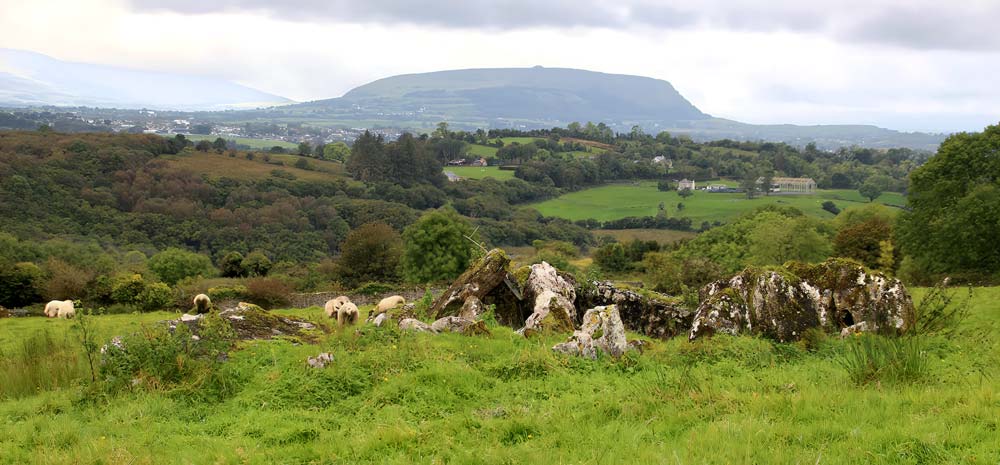
Hardman was puzzled that he could discover no local story attached specifically to Deerpark. Yet the monument hardly stands in a folkloric desert. Across the landscape, Knocknarea belongs to Maeve, the formidable queen of Connacht. Benbulben is associated with the death of Diarmuid Ua Duibhne, killed there by the enchanted boar. Lough Gill was said to cover an ancient settlement drowned when the lake burst forth. Deerpark stands within sight of this mythological company, even if its own inhabitants have remained stubbornly anonymous.
A short distance from the tomb are the remains of a much later stone fort, or cashel. When Seaton Milligan described it in 1891, enormous quantities of fallen stone lay in two great rings around surviving portions of the wall. Near the center was a souterrain, an underground stone-built chamber or passage associated with early medieval settlements. Other accounts mention two large cashels in the Deerpark, one reportedly wider than the Grianán of Aileach.9
The cashel and the court tomb did not belong to the same builders. The tomb was already several millennia old when the early-medieval fort was occupied. Yet the choice of this hill may not have been accidental. The cashel’s inhabitants lived beside a monument whose original meaning had vanished, but whose authority remained visible. Its massive portals may have suggested ancestors, giants, or merely the impressive works of people from an unknowable past.
The later occupants were not always reverent. Milligan observed that many stones had been removed to construct the wall around the Deerpark. The hill thus preserves not one archaeological moment but a long process of building, occupation, abandonment and reuse: limestone quarried for a tomb; stone assembled into a cashel; ancient masonry carried away for newer boundaries. Each generation inherited the work of the last, misunderstood it, and found another use for it.
Deerpark’s great distinction lies in this accumulated uncertainty. Archaeology can identify the monument as a Neolithic central-court tomb, describe its galleries, and confirm its funerary purpose. It cannot recover the words spoken in the court, the names of those whose bones were placed inside, or the beliefs that accompanied them. Folklore supplies a giant and perhaps a warrior named Cú-ruis, but it too stops at the stone thresholds.
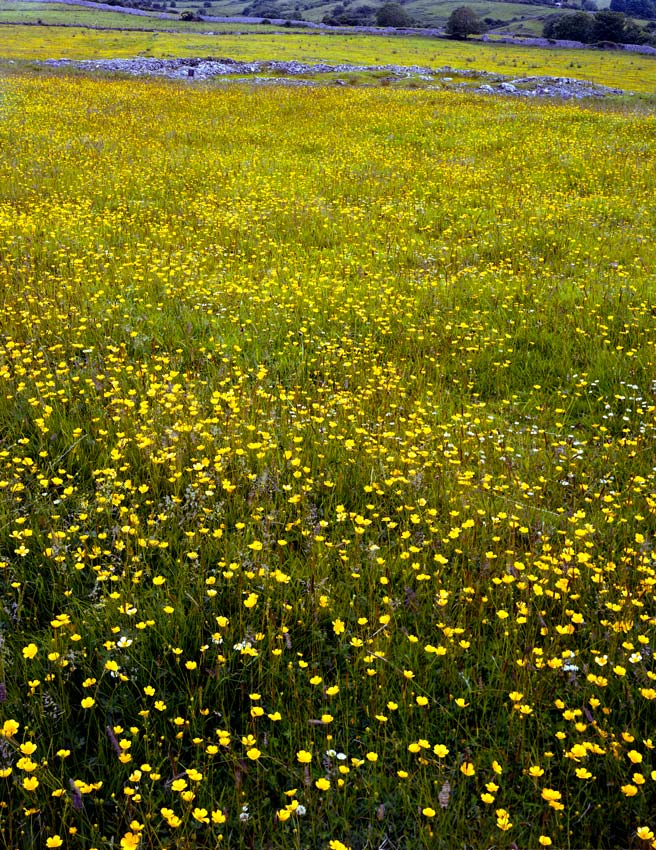
The later occupants were not always reverent. The covering stones of the court tomb were repurposed to construct the wall around the Deerpark. The hill thus preserves not one archaeological moment but a long process of building, occupation, abandonment and reuse: limestone quarried for a tomb; stone assembled into a cashel; ancient masonry carried away for newer boundaries. Each generation inherited the work of the last, misunderstood it, and found another use for it.
Deerpark’s great distinction lies in this accumulated uncertainty. Archaeology can identify the monument as a Neolithic central-court tomb, describe its galleries, and confirm its funerary purpose. It cannot recover the words spoken in the court, the names of those whose bones were placed inside, or the beliefs that accompanied them.
Click here to see all the notes from this page. Parts of this page were drafted using AI technology; all content has been edited by the author.
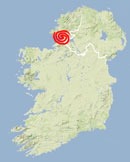
Magheraghanrush, Co. Sligo
Nearest Village: Calry
Nearest Town: Sligo
Latitude: 54° 16′ 45.14″ N
Longitude: 8° 22′ 50.14″ W